




Sun Exposure and Skin Damage
Sun damage may not be visible at an early age, but multiple studies warn of the consequences later in life. Sun exposure damages fibres in the skin called elastin, resulting in skin laxity. UV rays alter the DNA, causing saggy skin, lines, wrinkles, discolouration, age spots, and even cancer.
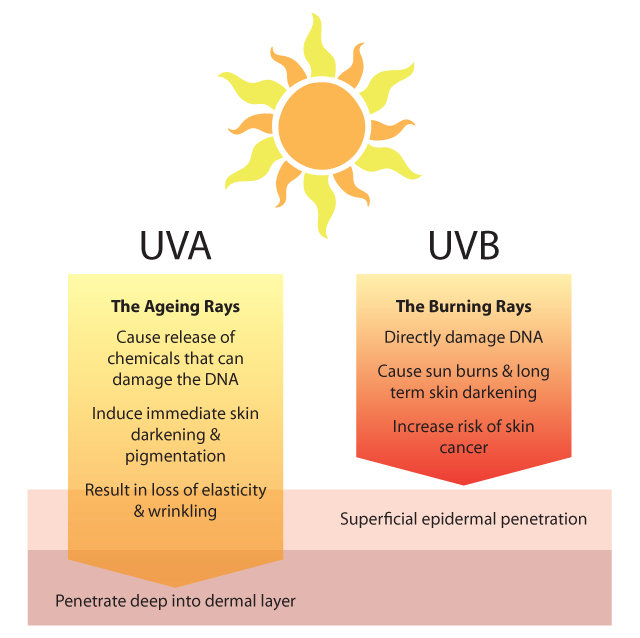
UV radiation is composed of two different wavelengths, UVA and UVB. When the skin is exposed to UV rays, melanin is photo-oxidised (immediate pigment darkening). This is the process that darkens your skin as it attempts to block out the radiation. Prolonged or repeated exposure to UV radiation results in persistent pigment darkening and eventually long term tanning (delayed tanning) which increases both the amount and activity of melanocytes. The delayed tanning process can last 10 days to several weeks, and with repeated exposure can cause DNA photo-damage.
UVB rays cause sunburn, but it is the UVA rays, with their longer wavelength that penetrate deep into the dermis, that are responsible for photo-ageing of skin. Sensitivity to sunburn is routinely evaluated by minimal erythema dose (MED). MED describes the lowest dose (J/cm2) of UV radiation that will cause erythema assessed 24 hours after exposure. Higher MED means higher tanning capacity. Darker skin is a result of increased number of melanin: it acts a barrier to the UV radiation.
Polypodium Leucotomos
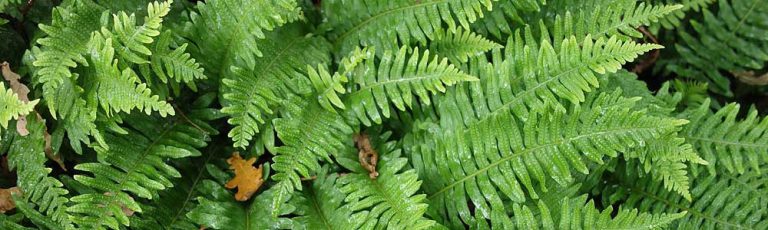
Polypodium leucotomos is a tropical fern plant native from Central America and parts of South America with a long history of usage by the natives in herbal remedies for skin issues.
Polypodium leucotomos has been extensively researched and its antioxidant properties fight free radicals from the environment to prevent long-term DNA damage and premature ageing and dullness of skin.
PhytoflORAL
Carotenoids are natural protectants found in plants. They absorb harmful UVA and UVB rays and suppress free radicals that lead to premature ageing and dark, uneven skin tone. The human body is unable to produce carotenoids, but they can be obtained through diet.EstheWhite’s key active ingredient, PhytoflORAL® is a patented innovative oral supplement derived from a proprietary source of non‐GMO tomato species that are rich in colorless carotenoids – phytoene and phytofluene. These specific carotenoids are known to lighten and even out skin tone through
Inhibition of constitutive melanin synthesis (reduces baseline pigment production)
Protection against UVA and UVB rays
Significantly increasing anti-oxidant processes
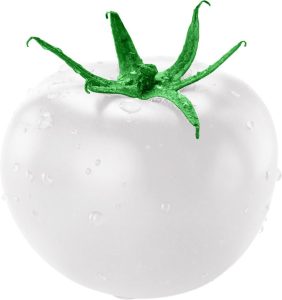
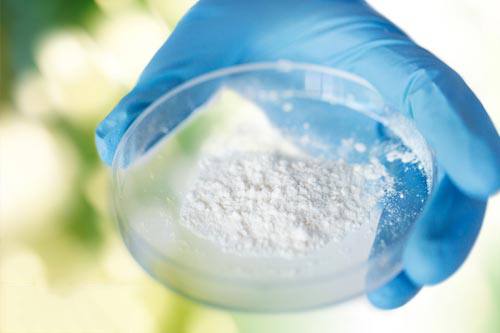
These carotenoids are truly colorless: they do not bleach nor stain the skin.
It has been shown to prevent the production of darker melanin, stimulate the production of glutathione, promote skin renewal and display anti-oxidant effects.
Clinical scoring of the skin quality was significantly improved in 60 to 86% of the panelists after 42 days and in up to 90% of the panelists
after 84 days (Table 3), across all parameters evaluated. Of particular interest, 95% of the subjects had improved skin evenness.1
Clinical scoring by the dermatologist presents significant improvement in skin dryness, roughness, suppleness, evenness and texture. Subjective evaluation questionnaire completed by the subjects presents improvement in skin radiance, evenness, hydration, smoothness, suppleness, elasticity and irritability. Study subjects found their skin more resistant to sun damage, more beautiful and visibly younger and healthier1.
Sunlight is a source for external/topical generation of hydroxyl radicals, as was demonstrated by Taira J. et al. This group suggested that sunlight exposure of skin may lead to hydroxyl radical generation and simultaneous lipid peroxidation2. Phytoene and phytofluene, the colorless carotenoids are one of the few anti-oxidants that are most effective in quenching of hydroxyl radicals (·OH) and shown in a number of publications.3, 4, 5, 6
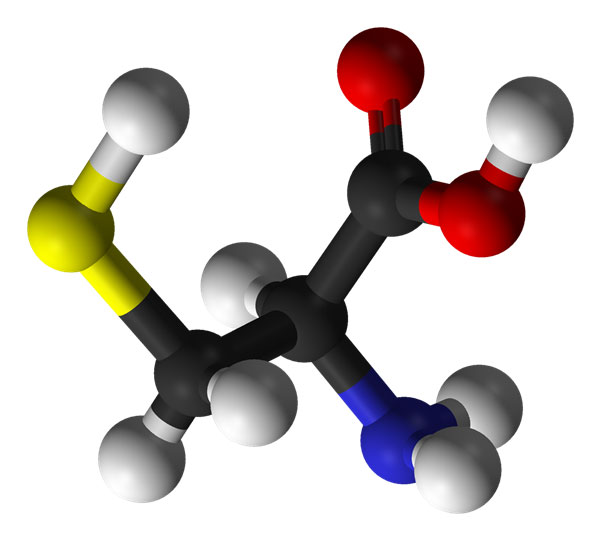
L-Cysteine
Glutathione, the major intracellular reductant, may become rate limiting to cytotoxic lymphocyte activation and proliferation under these circumstances. N-Acetylcysteine (NAC-cys) was used to increase intracellular glutathione levels significant changes in total glutathione (58% increase) at 96 hours. 1
Glutathione acts as a nucleophilic scavenger and as an enzyme-catalyzed antioxidant in the event of electrophilic/oxidative tissue injury. Therefore, glutathione has a major role as a protector of biological structures and functions. 2
Reactive oxygen species (ROS) are involved in various cellular events including cell proliferation, apoptosis and immune responses 3 L-cysteine is converted to intracellular gluthathione acting as a scavenger of ROS. 4
(1) Yim CY Hibbs JB Jr McGregor JR Galinsky RE Samlowski WE
(2) Klin Wochenschr (1991 Nov 15) 69(18):857-62
(3) Thannickal VJ, Fanburg BL (2000) Reactive oxygen species in cell signaling. Am. J. Physiol. Lung Cell Mol. Physiol. 279: L1005–1028.
(4) Kelly GS (1998) Clinical applications of N-acetylcysteine. Altern. Med. Rev. 3: 114–127.
 Beautescience
 Login with Google